
Ruth Pastine
The Luminous Presence of Color
Story by J.L. Cederblom | Photography by J.L. Cederblom
The building was bright, geometric, and unmistakably downtown Los Angeles. Waiting just outside to greet me was Ruth Pastine, bringing with her a flash of native New York energy and charm. She greeted me warmly, and almost immediately we were immersed in a conversation about art, process, and the nature of studio space. There was a focused ease to her presence—a painter’s discipline wrapped in genuine curiosity and care.
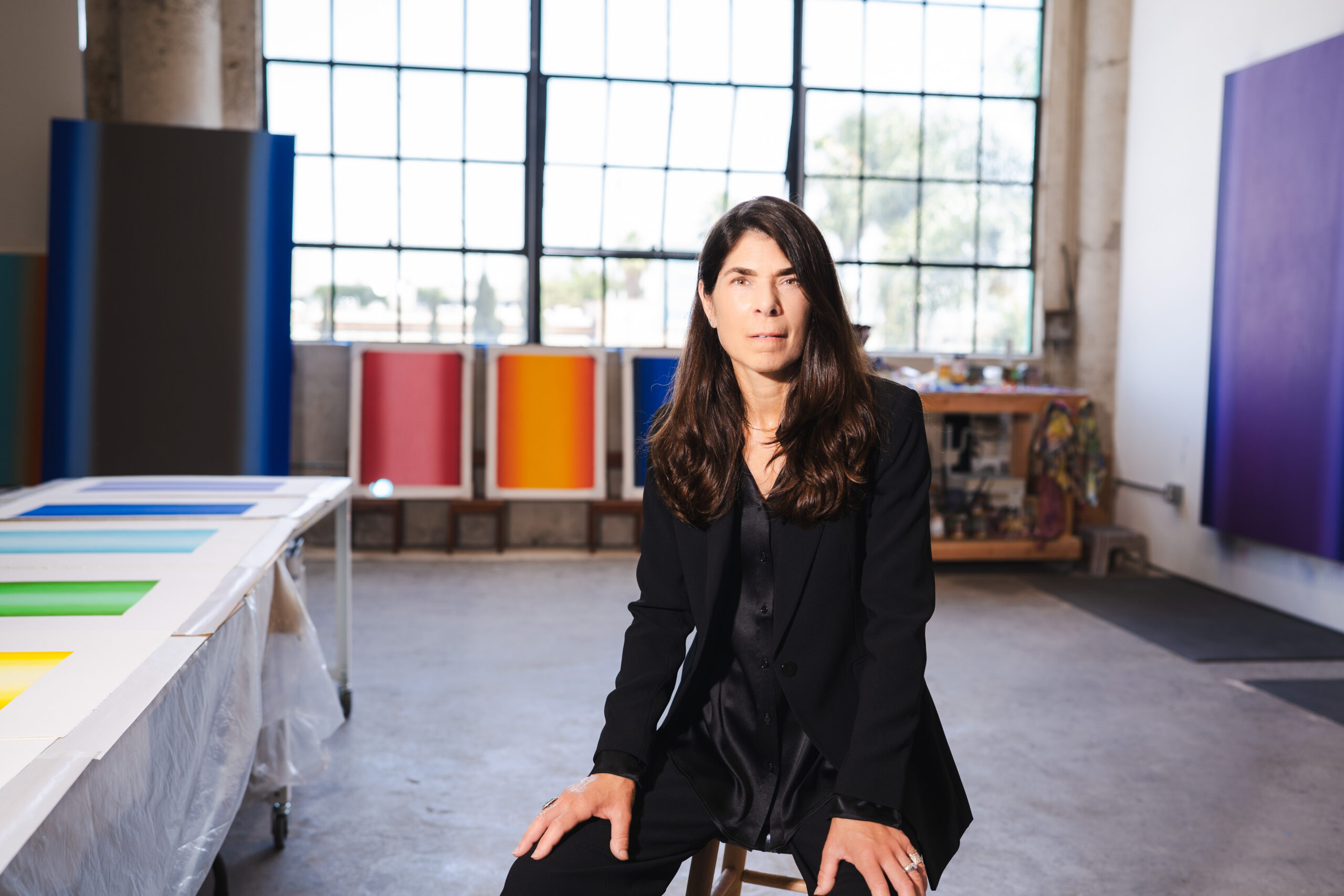
Inside her high-ceilinged studio, sunlight poured through a row of windows and landed on the paintings themselves—vast, radiant gradients that seemed to hover in silence. They didn’t just decorate the space; they charged it. Tables in the center were covered with works in progress, thin pastel veils resting over glimmers of raw color.
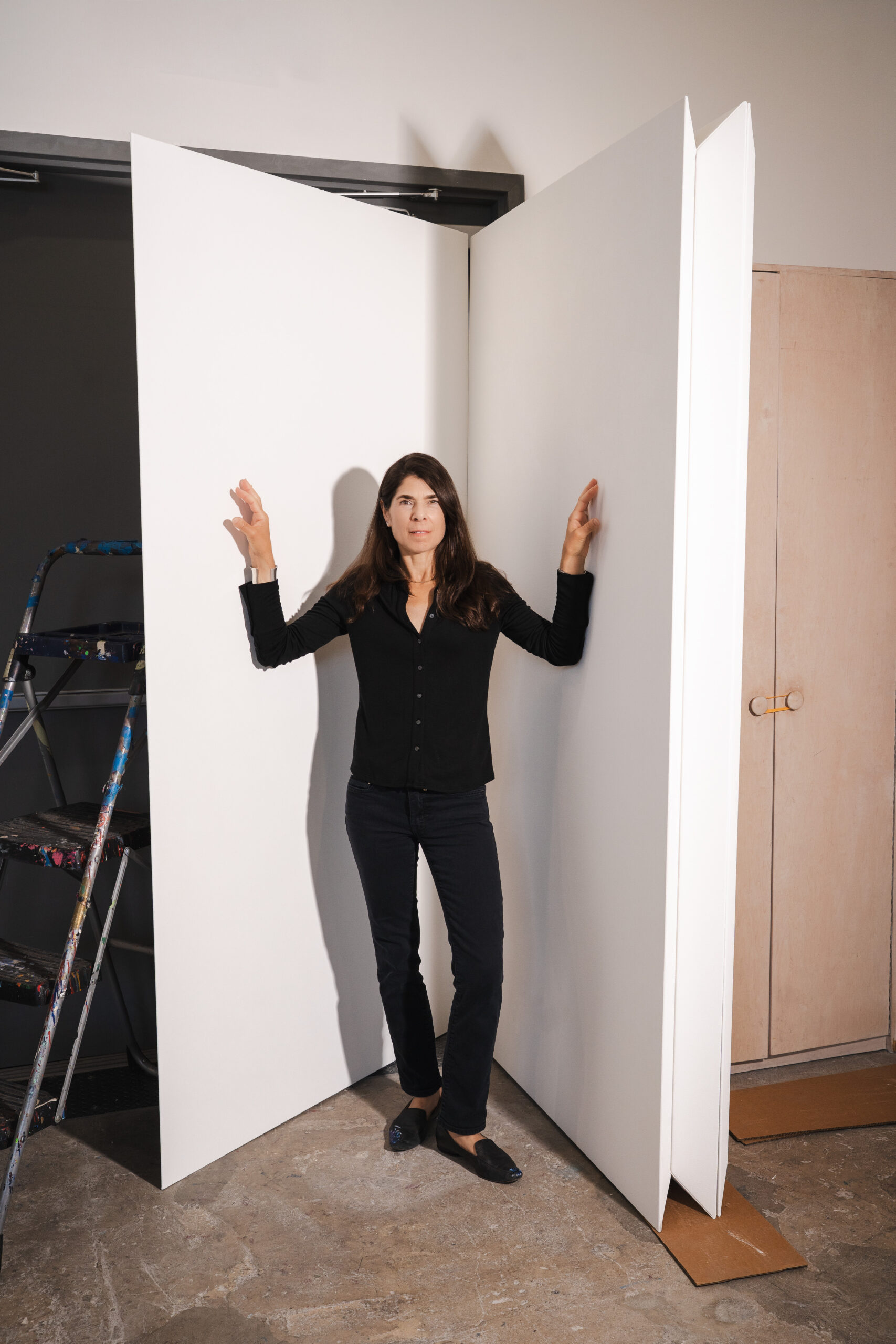
Pastine moved through the room with quiet reverence, explaining how her canvases evolved from square formats—neutral and centered—to the towering verticals she now paints. “They operate much like skyscrapers conceptually, between two worlds,” she said, reflecting the shift from New York’s concrete canyons to the openness of the West. “The square format was about theory,” she noted. “The verticals are visceral and architectural. We stand vertically in space—there’s a direct relationship to the body.”
The Discipline of Process
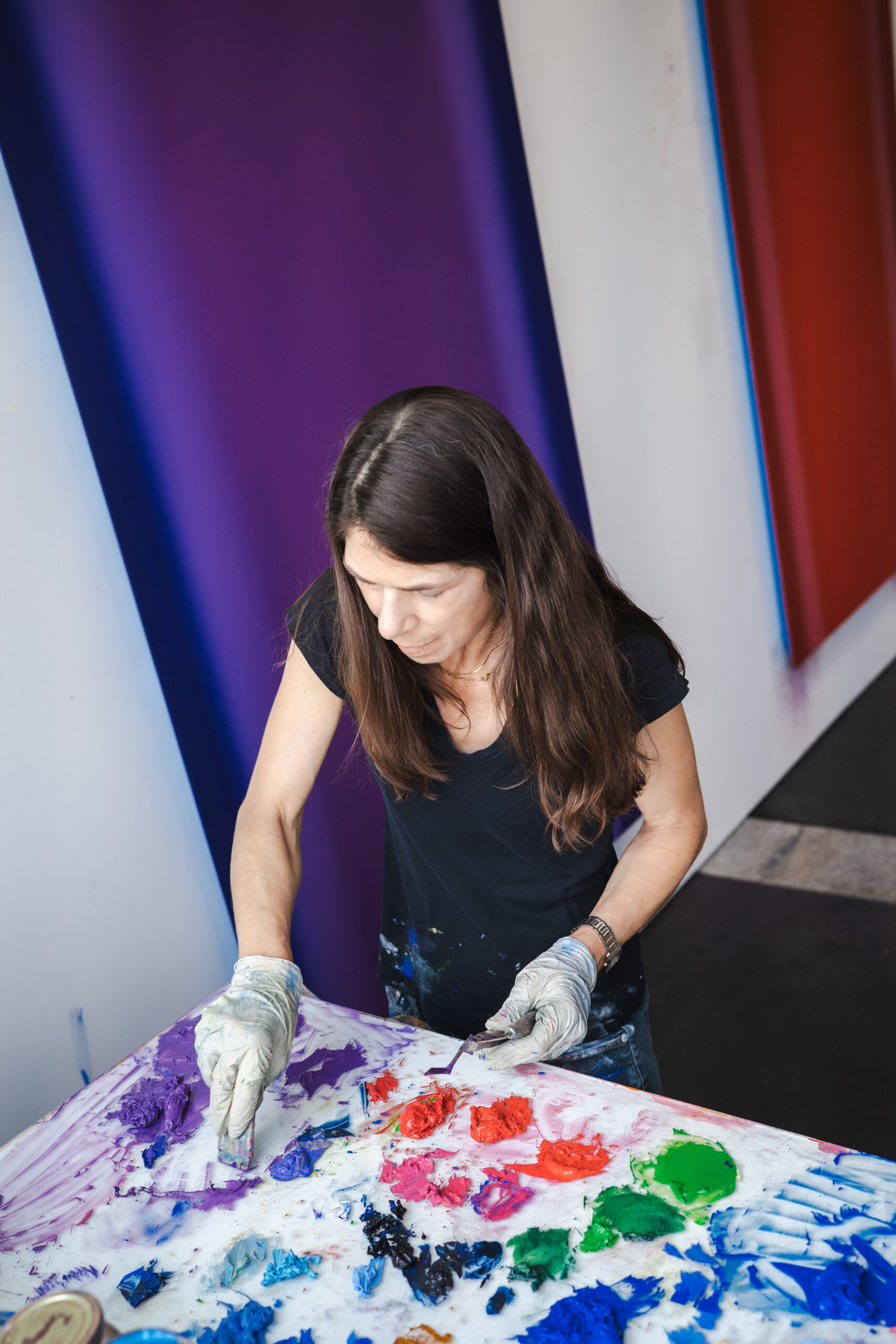
Despite their meditative stillness, Pastine’s paintings are physically demanding to make. Each begins with a single, deliberate brushstroke in the center—what she calls breaking the silence of white.
“It’s how I confront the void,” she said. “That first stroke breaks ground and opens infinite potential.” Her process is muscular and methodical, requiring ladders, layering, and patience. Paintings may take months to complete. She doesn’t sketch or plan compositions in advance; instead, she builds intuitively, allowing the work to lead. “It’s a dance,” she said. “Like music and choreography—it takes discipline and repetition to evolve a rhythm and flow. Then, when I let go of the known, something transcendent happens.”
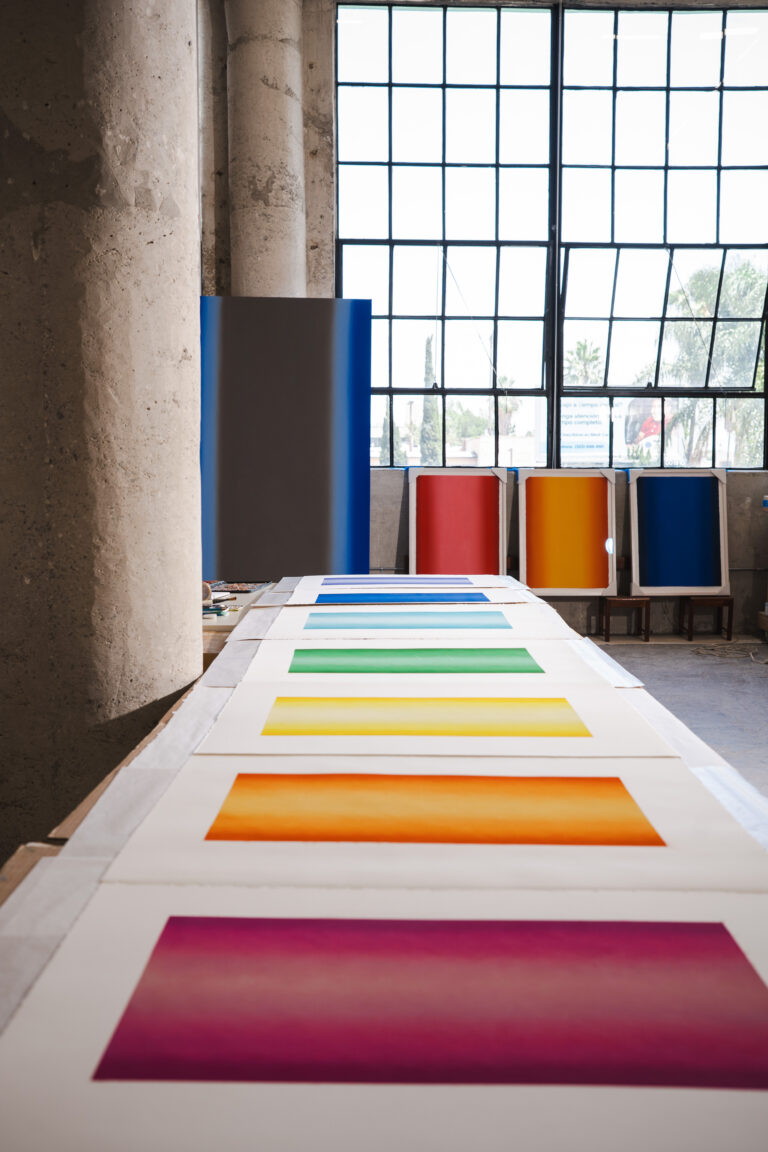
"When I immerse myself in the workshop, I enter into a timeless space, enlivened by a delicious cup of coffee!”
Art as Devotion
Raised in New York City, Pastine grew up surrounded by the arts—painting, modern dance, classical music, and Broadway theater. Her mother exposed her early to the avant-garde and gave her permission to experiment.
“My family and I just saw the Alvin Ailey Dance Company again,” she told me. “That level of artistry doesn’t come from inspiration alone—it comes from returning to the practice every single day. That focus, that discipline—that’s where the magic happens.”
She draws a similar lesson from cellist Yo-Yo Ma. “His mastery transcends rigor and touches the soul,” she said. “We all must reckon with the existential angst of being human. I do it through painting.”
For Pastine, transcendence through repetition is the key. What appears minimalist from afar is, in truth, the product of extraordinary control—and surrender.
“The paintings start with structure—symmetry, color systems, value shifts—but the real work happens when I stop thinking,” she said. Ruth cites Agnes Martin, who believed the mind should stay outside the studio. “Of course we think. But the mind can distract from presence. And presence is where the paintings engage.”
Color as Subject
Color is not a tool for Pastine—it is the subject itself. Her systems begin with primaries and evolve through subtle tonal shifts. A single hue can change entirely depending on its context.
“Same format. Same dimensions. Different color. Entirely different phenomenon.” She approaches color through phenomenology, not to explain but to open perception. “The work isn’t narrative,” she said. “It locates the viewer in the present moment of discovery—bringing awareness of yourself as you’re seeing.”
Standing before one of her paintings, the viewer questions whether the color is advancing or receding, whether the surface is flat or deep. The ambiguity becomes the experience. “That’s the moment I’m interested in,” she said. “When you realize you’re not just looking—you’re perceiving.”
Beginnings and Belonging
Pastine’s influences span from Fra Angelico to Malevich, but Claude Monet first captured her imagination. “He eliminated the horizon line,” she explained. “Those water lily paintings are immersive and existential.”
Her first studio wasn’t a loft but her childhood bedroom. “My stepfather built it when I was seven—a long drafting table that ran the length of the wall. It was one of the greatest gifts: a space to create, discover, and work.”
That sacred creative space shaped her sense of possibility. “Studio is home,” she said simply. “It always has been.”
“It wasn’t until sundown that the palette exploded in the cooling night air. Boom! That was the moment.”
Desert Light and Revelation
After years in New York’s SoHo, Pastine and her partner, artist Gary Lang, unexpectedly lost their lease. A trip to Arizona—at the invitation of James Turrell—opened a new chapter. “Friends said, ‘You’ll love the color in the painted desert,’” she recalled. “But in the bright light of day, color was elusive. It wasn’t until sundown that the palette exploded in the cooling night air. Boom! That was the moment.”
The desert revealed its lush spectrum only in transition—in the liminal space between light and dark. “That’s the phenomenology of color,” she explained. “It’s not just hue—it’s context. What’s present makes something else visible. It’s about contrast, relationships, and relativity.”
Toward a New Horizon
Now, with an upcoming solo exhibition at the Frederick R. Weisman Museum of Art in Malibu in 2026, Pastine describes her new work as both continuation and culmination. The museum recently received works by artists who influenced her—John McLaughlin, Josef Albers, and Ellsworth Kelly. “The invitation to exhibit there felt aligned—a full-circle moment,” she said.
To prepare, she opened her downtown LA studio, designed to see the entire body of work at once. “I wanted to feel the dynamics of what it would be like for the viewer entering the gallery,” she explained. The studio became not just a workspace, but a rehearsal for how the art would live in the world. The show will coincide with the release of a 20-year monograph, chronicling her evolution and dedication.
“There’s a moment when the work stops asking for more and pushes back.”
The Grace to Let Go
When I asked how she knows when a painting is finished, Pastine smiled. “I bring my intentions—scale, color, structure—but ultimately the paintings evolve on their own. It’s when the known and unknown find balance.”
She told me of one piece she intended to rework. “After it dried, I realized it was already speaking. It revealed something I hadn’t planned, and I had to ask if I was willing to accept that. I’m still considering whether to call it finished. That’s part of the process, too.”
Her openness to dialogue with the work—listening rather than forcing—defines her philosophy. “There’s a moment when the work stops asking for more and pushes back,” she said. “And when I’m present to receive it, I see it. There’s a moment when the work stops asking for more and pushes back.”
Pastine does not chase perfection. She cultivates clarity, space, and presence. Her courage lies in returning to the canvas each day, surrendering control, and allowing light and perception to guide her.
In that delicate space between structure and surrender, between intention and the unknown, something luminous emerges. Not a message. Not a meaning. But a presence.
Standing before her paintings, the world seems to pause. Thought loosens its grip. What remains is a quiet noticing—a suspension of interpretation. You’re not just seeing—you’re sensing. Simply, and entirely, here. –