Kristin Chenoweth

The Broadway Star Talks Grace, Grit and Why Art Always Endures

Story by S.S. Thompson | Photographs by Tony Matula

When Broadway producers Stephen Schwartz and Bill Damaschke, along with writer Lindsey Ferrentino, approached Kristin Chenoweth about transforming the documentary Queen of Versailles into a musical, the acclaimed performer hesitated. A billionaire’s tale didn’t exactly strike her as universal theater. Yet curiosity won out. “That’s when I realized,” Chenoweth recalls, “oh, this is a cautionary American tale about the pitfalls of fame.”


During the musical’s recent Boston run, she discovered deep empathy for Jackie Siegel—the titular “Queen.” What began as skepticism evolved into a study of perspective, privilege, and vulnerability. Now, following Queen of Versailles’s Broadway run, which concluded with its final performance on December 21, 2025, Chenoweth’s portrayal resonates as a timely and thoughtful examination of the American dream.


From Oklahoma Roots to Broadway Royalty


Unlike the woman she portrays, Chenoweth’s own rise to fame was anything but accidental. Raised in rural Oklahoma by adoptive parents who were engineers, not artists, she found her calling through gospel choir. What began as a passion for opera eventually led her to Broadway, landing her first role in Steel Pier, which earned her a Theatre World Award.

"My parents didn’t know the world I was entering, but they believed in me. That belief is everything.”

"That’s when I realized—oh, this is a cautionary American tale about the pitfalls of fame.”

Her career since has been a dazzling sweep across stage and screen: Tony and Drama Desk Awards, an Emmy for Pushing Daisies, a Grammy for Wicked, and a long list of credits that have made her a household name. Through it all, she remains grounded. “The sacrifices one makes for this career are wild,” she reflects, “but I chose them.”

That grounded awareness fuels her artistry. When embodying a character like Jackie Siegel—a woman many might judge superficially—Chenoweth approaches with empathy and research. “I’m not looking to imitate, but to capture her energy and her way,” she explains. Her gift lies in transformation without imitation, bringing vulnerability to even the most glittering roles.

“For Broadway audiences, I’ll always be Glinda—and that’s an honor I’ll never take lightly.”

The Good Witch

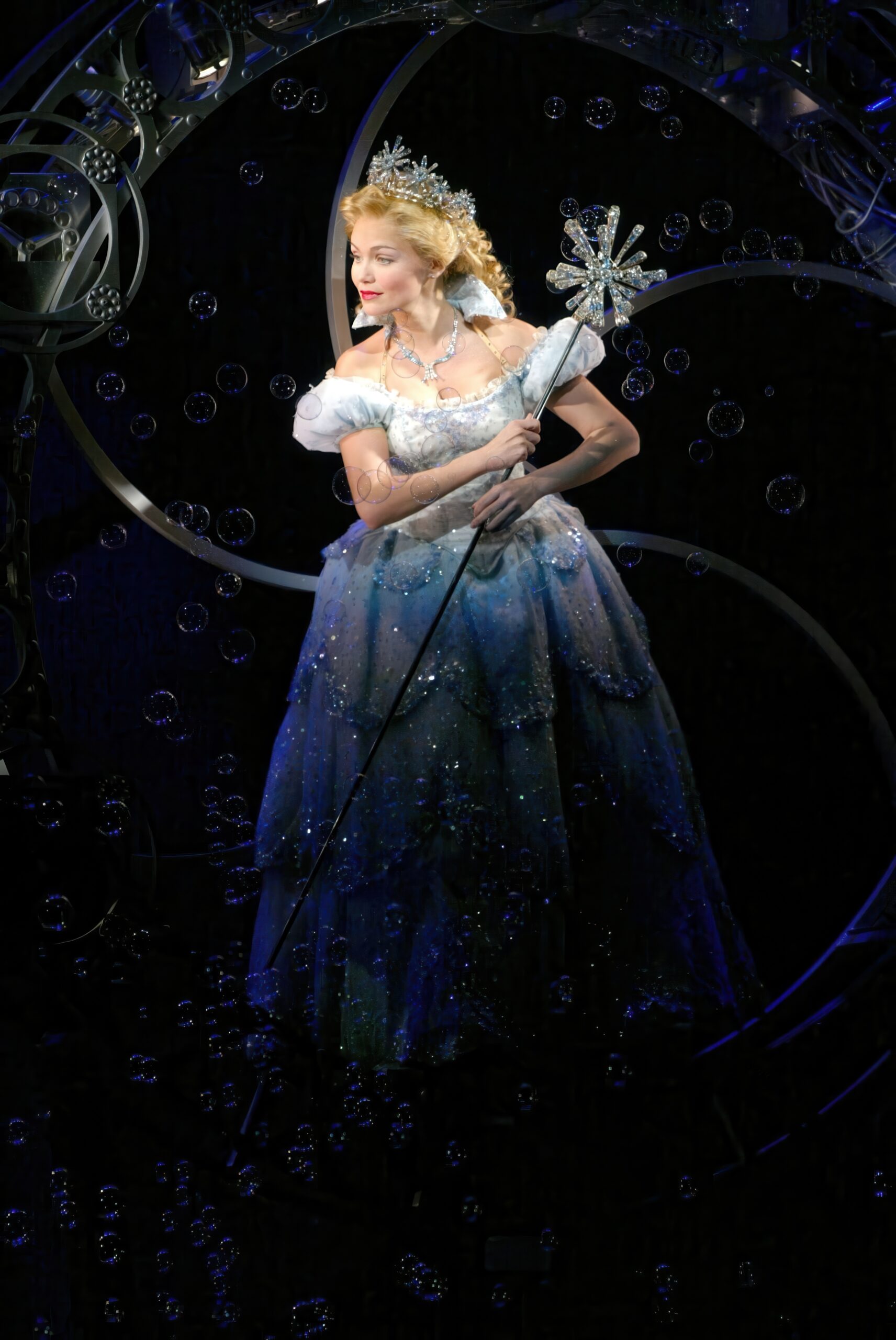
For Broadway audiences, Kristin Chenoweth will always be remembered as the original Glinda in Wicked—the radiant, effervescent “Good Witch” whose charm, humor, and crystalline soprano defined one of the most beloved musicals of the century. Her performance didn’t just earn her a Tony nomination; it shaped the very DNA of modern musical theater.

As Wicked came full circle with its highly successful film adaptation, Chenoweth once again found herself intertwined with its legacy—this time appearing  in a delightful cameo nod to her beginnings for the song One Short Day.  “Returning to that world has been surreal,” she admits. “This piece is about love and friendship and forgiveness—things that have been hard for me.”

Life has tested her sense of loyalty, and like Glinda, she’s learned that forgiveness—especially of oneself—is a lifelong lesson. “When I hear the ‘Blame Song’ now, it resonates differently,” she shares. In revisiting Wicked, both on screen and in spirit, Chenoweth has found a mirror for her own evolution—proof that the art we make can grow up with us.

Grace, Grit, and Growth

Sustaining a career as luminous as Chenoweth’s takes discipline of mind, body, and spirit. “If you focus on self-care, getting into character is easy,” she laughs. Once known for running on a treadmill while singing to expand her lung capacity, she now swears by hot yoga and meditation.

The shift reflects not just time, but growth. Having spoken openly about past struggles with eating disorders, she’s embraced vulnerability as a form of strength. “I was raised to ‘suck it up, buttercup,’” she says. “Now I know it’s okay to show what’s real.” Chenoweth has come a long way from showcasing only the “rainbows, glitter and unicorns” to being honest about what is really going on internally. She admires the courage and openness of younger generations and is finding freedom in sharing her own struggles.

Perfectionism still drives her, but wisdom tempers it. “The hardest part is leaving the character at the theater,” she admits. Portraying Jackie Siegel, in particular, triggered unexpected sadness—“a woman searching for her own comeback.” Yet through the process, Chenoweth found healing. “We sing because we can’t speak the feeling,” she muses, “and dance is an extension of that.”

"When I hear the ‘Blame Song’ now, it resonates differently. The art has grown up with me.”

Passing the Flame

Believing in the transformative power of art, Chenoweth founded Broadway Bootcamp in her home state of Oklahoma—a haven for young performers now celebrating its tenth anniversary. The camp draws talent from across the globe, and many alumni have gone on to shine on professional stages. In a full-circle moment, one former student, Tatum Hopkins, was cast in Queen of Versailles. “Seeing that happen—it’s everything,” Chenoweth beams.

The program also offers workshops for parents, inspired by her own family’s journey raising an artist. “My parents didn’t know the world I was entering, but they believed in me,” she reflects. It’s that belief she hopes to extend to the next generation—because belief, after all, is the first act of creation.

The Artist’s Heart

Through accolades and applause, Chenoweth remains steadfast in her purpose: to make art that heals. “I’ve always loved Leonard Bernstein’s quote: ‘This will be our reply to violence: to make the most beautiful music in the world.’”

As The Queen of Versailles takes its place in annals of Broadway, Chenoweth’s performance was transcendent to glitter and spectacle—it became a reflection on resilience, compassion, and the human spirit.  Her reign will continue, not because of crowns or titles, but because she leads with heart.

The Queen of Versailles concluded its run on a production that challenged audiences to look beyond spectacle and into the complexities of ambition, reinvention, and the American dream. For Kristin Chenoweth, the role marked not just another return to Broadway, but a personal chapter—one defined by empathy, growth, and artistic courage.  –