
Culture
Prince of the Beach
Tao Ruspoli and the Art Biennale at the End of the World
I met Tao Ruspoli in the Spring of 2017 in a small derelict town on the shores of Salton Sea, called Bombay Beach. Together with friends, art patrons and entrepreneurs Stefan Ashkenazy and Lily Johnson White, he co-founded Bombay Beach Biennale — an annual art gathering in response to the environmental disaster that fell upon the Salton Sea in the 1980s. Tracy Chung, one of the biennale organizers and art collectors, who I had met a couple of years back at a gallery in New York, invited me to create an immersive talk show documenting the experience — an indulgence of my fascination with site-specific art and dereliction.
I was already aware of the artist interventions happening in that area, but Bombay Beach was so much more than I could have imagined.

"Many people don't know that Salton Sea is the largest body of water in California, created by accident in 1905 when they were damming the Colorado River to bring water into Southern California," explained Tao. "It was the breach in the dam that caused it. For two years they couldn't control the flooding and the contents of the Colorado River spilled into this low, ancient riverbed, 250 feet below sea level." In the 1950s and 1960s the area became a popular tourist destination visited by the likes of Frank Sinatra, President Eisenhower and The Beach Boys — but in the 1980s, due to farm runoffs and increasing salinity, the sea got contaminated, most of the wildlife died, and Bombay Beach became an abandoned resort town.

Open to conversation and bursting with enthusiasm for the movement he had started, Tao was coordinating everything from moving airstreams — turned art galleries — to large otherworldly installations and thought-provoking sculptures. Our walk led us to the epicenter of Bombay Beach Biennale: The Bombay Beach Institute of Particle Physics, Metaphysics, & International Relations — part museum/gallery, part performance space, part sculpture park featuring elegant gardens with chickens and rabbits running around, like a scene out of a Wes Anderson film.
His mother, Austrian-American actress Debra Berger, was there too — helping other artists bring their visions to life, her sleeves up, holding a welding gun. This was not a public event. It was a secret gathering of art connoisseurs, writers, philosophers, opera singers, dancers, performers and intellectuals, eager to engage with this landscape and turn it into a site of critical contemplation. Did I mention there was a museum where you could hold a real human brain?

The Prince
Unsure if I had met a mad scientist, an architect, or a philosopher, I immediately took a liking to Tao — not just because we had similar interests, but because talking to him was like engaging with a character from a well-written novel. It only got better when I later found out that Tao was the second son of an Italian Prince, Alessandro "Dado" Ruspoli — a very eccentric, rebellious, and unconventional man who in part inspired Fellini's film La Dolce Vita. "My father was friends with all of these amazing creative people — Cocteau, Dalí, Picasso and Orson Welles — who were questioning conventional art, morality and lifestyle," said Tao, who studied Philosophy at Berkeley and went on to become a filmmaker and photographer.
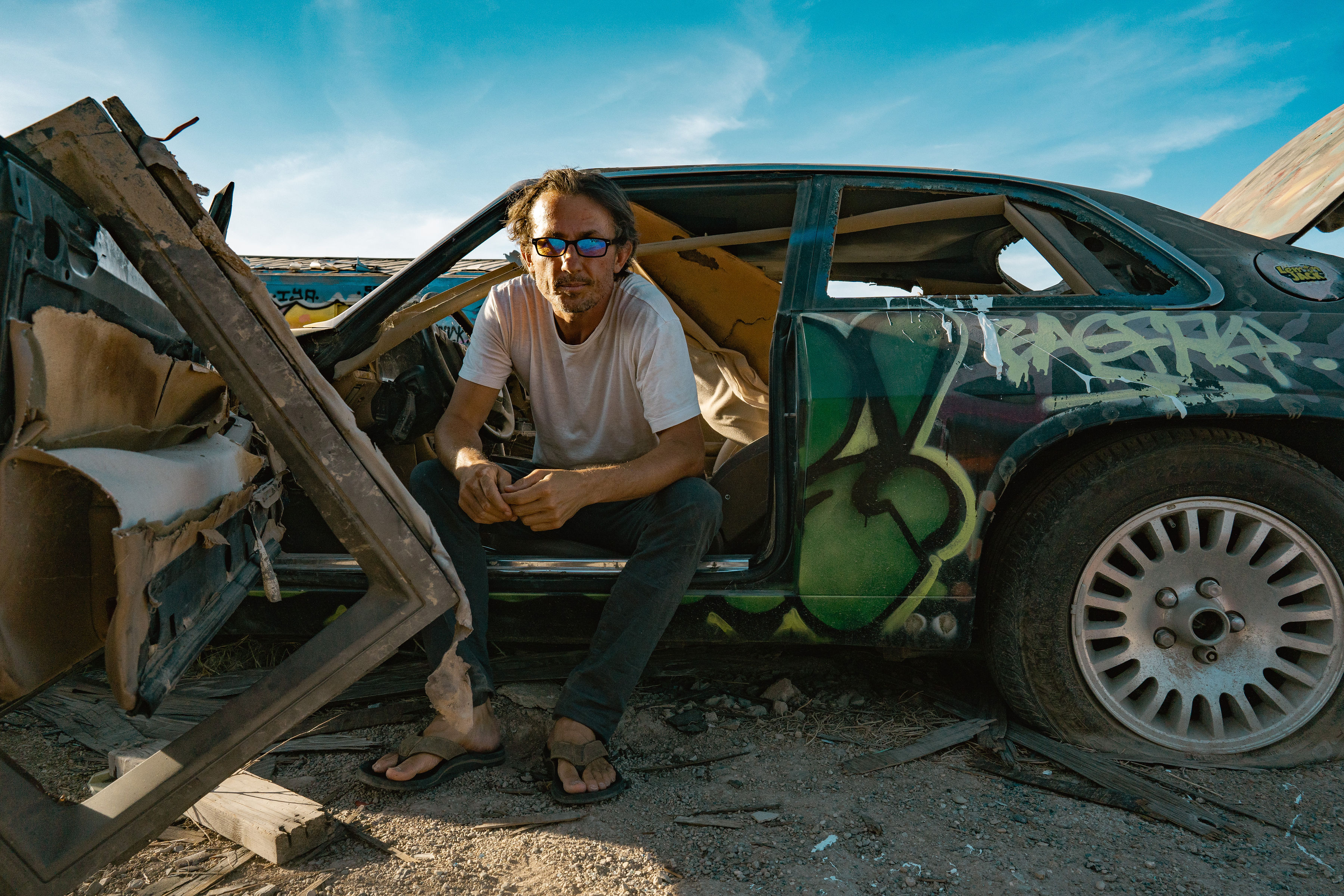
That evening I walked around Bombay Beach, admiring the works of Randy Polumbo, William Attaway, Stefanie Schneider, Alexandra Sand, Steve Shigley and Damian Elwes. I dove into incredible installations like vortexes scattered around this remarkable town that had become a Mecca for hungry intellectuals. Inside the graffiti-covered ruins were philosophy talks by Ivy League professors. Towering over the crushed fish carcasses that make up the beaches of Salton Sea was an Opera House — designed by James Ostrer — where world-renowned dancers and opera singers shared a stage. Further along, on Avenue E, was an eerie, retro drive-in movie theater made from old, lined-up discarded cars. Each place had been touched by the hand of an artist, brought back to life, revitalized.


A Rupture in Time
"Why do we like ruins? Why are ruins so compelling to us? My friend Mark Wrathall, who is Professor of Philosophy at the University of Oxford, said that in everyday existence we think of time as linear. And what ruins represent is a rupture in time. Because if time followed the trajectory that people imagined, then there wouldn't be ruins, right? A ruin is time taking a detour," explained Tao, with a glimmer in his eye.
"Bombay Beach is a combination of so many things I'm interested in — the desert, Americana, and a more critical perspective on the American Dream, because it really represents the American Dream gone wrong. This kind of detritus of America."
Growing up in California, Tao says he had a very normal upbringing, going to public school and moving from house to house a lot — but every summer he would return to Italy and have an otherworldly experience in the family's castle, Castello Ruspoli, which has been in their possession since the 1500s.
Tao discovered Bombay Beach in 2008 when he came across a book by UC San Diego professor Kim Stringfellow. He was immediately drawn to the cover — a rotting airstream in a puddle of strange orange liquid. "I was just so in love with this place right away, even though it smelled funky and felt a little dangerous, and I started bringing people there. At the time I was married and I said to my wife, 'we should buy a house in Bombay Beach,' and she looked at me like I was insane. I was like, 'but it's cheaper than your Jetta!'" He bought his first property in 2009 — on 1st and E, now known as the Palazzo.

People would come to Bombay Beach to shoot music videos, with a "ruin porn" attitude — no curiosity about the people who lived there or what had happened. "That started to get on my nerves as a new homeowner, and I thought the opposite of this would be to bring high art to Bombay Beach — to bring serious philosophy," he shared.

Bombay Beach Biennale

An annual secret gathering of art connoisseurs, writers, philosophers, opera singers, and intellectuals — Bombay Beach Biennale transforms a forgotten resort town into a site of critical contemplation.
Filmmaking as Therapy
Tao has always been interested in everything, and filmmaking was the only thing that would allow him to pursue his eclectic interests. He was obsessed with flamenco and made a film about it. Then he became interested in Heidegger and made Being in the World — also the name of his podcast. His divorce sparked an interest in relationships and sexuality that led to Monogamish. "Why does marriage exist as an institution? And why does monogamy exist as an ideal? I spent four years traveling the world exploring those questions." His brother's struggle with addiction inspired Fix, about a charming, larger-than-life heroin addict and the two brothers navigating it. Filmmaking, for Tao, has been a kind of therapy — a way of understanding and coming to terms with what is happening in his life.


Aside from Bombay Beach Biennale — which has coincidentally become a life-defining project — Tao lives in the desert and runs a beautiful compound in Yucca Valley through Airbnb: luxurious cabins, charming airstreams and trailers surrounding an 80-foot swimming pool that slices right through the middle of a Joshua Tree grove. This is where the architect in him came fully to life — and he claims to have met more interesting people through his compound than he ever would have in Los Angeles.
When he wakes up in the morning, all he wants to do is play music. He spends most of his time at the piano, perfecting his interpretation of Chopin's Fantasie Impromptu. "I've been playing music since the age of 13 and in a way it's the most pure art form, because it's not necessarily representational of something else. It has its own intrinsic beauty." Never in a million years had he imagined he would be living in the desert and co-founding an art movement. If you are interested in diving deeper into the mind of this brilliant, eccentric, eloquent and curious man, be sure to follow his podcast Being in the World — co-hosted with neuroscientist Dr. Patrick House and streamed on all major platforms from Tao's recording studio in Yucca Valley.

— Tao RuspoliThe opposite of ruin porn is bringing high art to Bombay Beach — bringing serious philosophy to a place the world forgot.
