The Milken Butterfly
How One Conference Gives Rise to New Ventures, Collaboration, and Capital
Story by Aury Mubarak Journe & Leah Pollack | Photographs by Loreto Villarreal Monterrey N.L.
A Gathering Unlike Others
Every spring, Beverly Hills becomes the temporary home of an unusually concentrated gathering of human ambition. The Milken Institute Global Conference draws heads of state, Nobel laureates, founders, investors, physicians, philanthropists, and policy architects under one roof for several days of structured dialogue and unstructured encounter. Organized by the Milken Institute, the conference was shaped by the vision of Michael Milken, whose career has been defined by a singular conviction: that access to capital, education, and public health are not separate issues but interconnected conditions of human possibility.
The conference is not a trade show. It is not a summit in the traditional sense. It is, more precisely, a collision environment. Ideas move quickly in its ballrooms and corridors. Partnerships form between people who had no reason to meet before that week. Investments are seeded and initiatives are born. And then the week ends, and everyone returns to their separate worlds.
Or so it appears.
The Butterfly Effect in Human Systems
In chaos theory, the Butterfly Effect describes a phenomenon in which a small and seemingly insignificant event creates a chain of consequences that, over time, produces an outcome vastly larger than its origin. The flap of a butterfly’s wings in one place, in theory, influences a storm forming on the other side of the world. The mechanism is not magic. It is sensitivity: the right initial condition, meeting the right system, at the right moment.
The Milken Institute Global Conference operates this way. Its value is not contained within the days of the conference itself. Its value is what it sets in motion. A conversation over breakfast becomes a partnership six months later. A chance introduction leads to a collaboration that neither party could have designed in advance. Small movements of connection, made in a specific environment of trust and shared purpose, ripple outward into ventures, institutions, and ideas that reshape industries and lives.
Small movements of connection, made in a specific environment of trust and shared purpose, ripple outward into ventures, institutions, and ideas that reshape industries and lives.
With the 2026 conference upon us, this article is about one such ripple. It began with a Monarch Butterfly poncho and a case of mistaken nationality. It has since grown into a structured initiative operating across three countries with a framework designed to address one of the most pressing and underexamined challenges of our time—the transmission of wealth, knowledge, and human capacity across generations.
But to understand what was built, one must first understand the danger it was built to address.
The ability to think independently, to construct an original argument, to sit with complexity without immediately seeking an algorithmic answer — these capacities form what we define as Brain Power Capital.
Brain Power Capital: The Resource We Are Quietly Losing
We are living through a technological transformation that is, by any measure, extraordinary. Artificial intelligence can now write, reason, diagnose, design, and decide at speeds and scales that no human can match. The tools available to an individual today would have been unimaginable to a research institution two decades ago. This is, in many respects, a remarkable gift.
It is also a risk that we have not yet learned to name clearly.
When a cognitive task is outsourced to a machine repeatedly and over time, the human capacity to perform that task independently begins to atrophy. This is not a speculative concern. It is the straightforward logic of any system: what is not exercised weakens. We have seen it with physical labor, with navigation, with memory. We are beginning to see it with reasoning itself.
The ability to think independently, to construct an original argument, to sit with complexity without immediately seeking an algorithmic answer, to exercise judgment in the absence of data, these capacities form what we define as Brain Power Capital. It is not intelligence in the narrow sense. It is the cultivated, practiced, and disciplined power of the human mind to reason, create, discern, and decide on its own terms.
Brain Power Capital, which we refer to throughout as Brain Capital, is not equally distributed, and it is not self-sustaining. It must be built deliberately, through education grounded in real inquiry, through engagement with art and philosophy and craft, through the discipline of research, through the habit of asking questions before accepting answers. In an environment that rewards the convenience of automated thinking, those who maintain and develop this capacity will hold a form of value that no technology can replicate or replace.
They will be, in the most literal sense, the most valuable people in any room.
This is the urgency that sits beneath the work described in the prose that follow. It is not abstract. It is measurable at the level of families, institutions, and economies. And it is the foundation on which The Generation Initiative was built.

An Origin: Beverly Hills, 2025
At the Milken Institute Global Conference 2025, a small moment occurred that would, in the months ahead, prove to be exactly the kind of initial condition the Butterfly Effect requires.
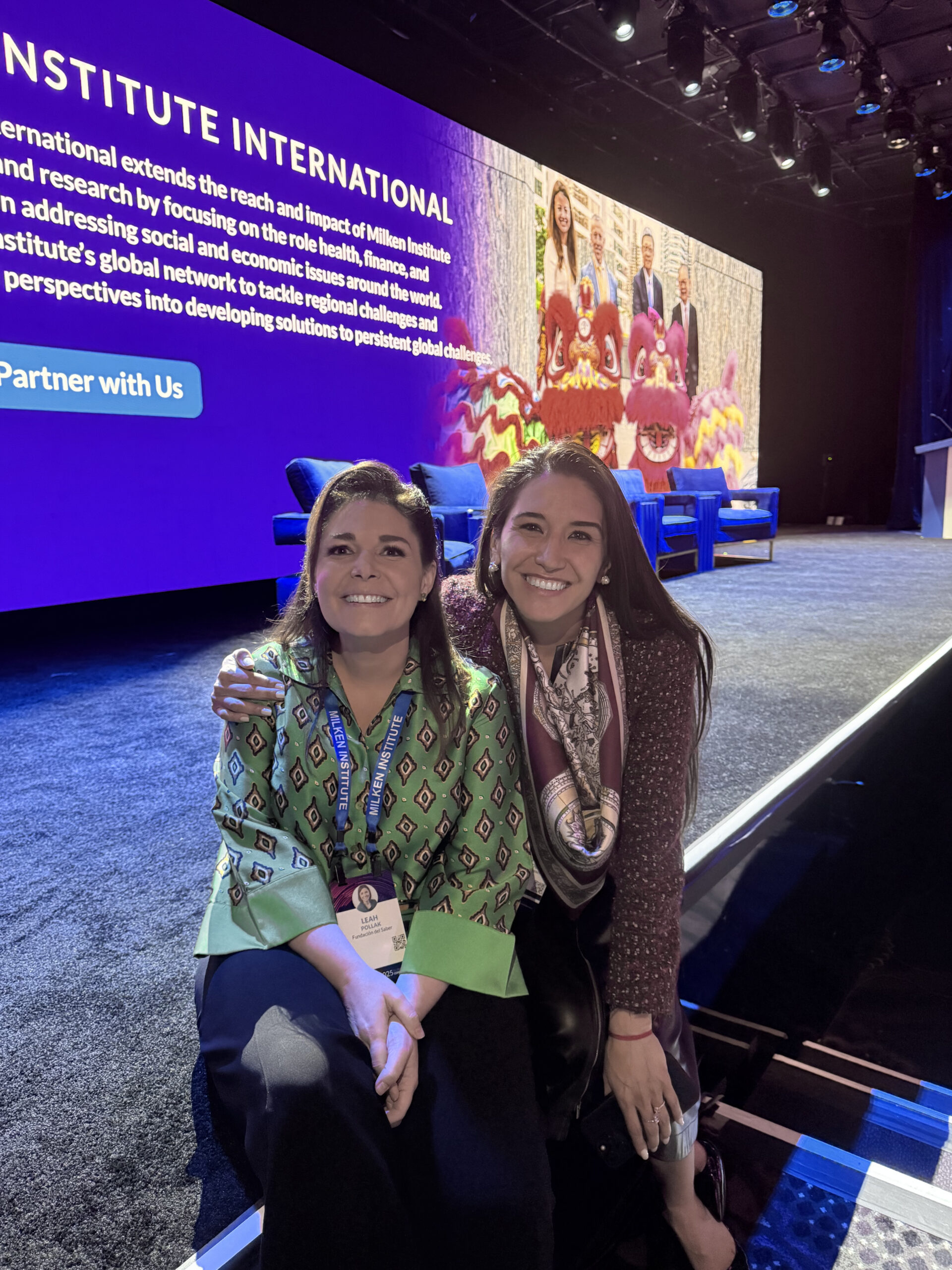
I noticed a Monarch Butterfly poncho, the unmistakable handiwork of the Mexican design house Pineda Covalin, and asked its wearer if she was from Mexico. She was not. Her name was Leah Pollak, a Chilean, and the CEO of Fundacion del Saber, an institution built on the conviction that the binding constraint on human development is not only the availability of capital, it is the capacity to use it well.
Fundacion del Saber carries a verified 6.79x Social Return on Investment, grounding its work in measurable outcomes rather than aspiration. Leah brings to every collaboration a rare discipline: the ability to translate intention into governance, and vision into structure. We began to talk, found an immediate and unexpected resonance, and parted ways at the end of the conference week.
But our connection did not end. It continued, deepened, and over the following months became something neither of us had planned: a formal co-founding partnership, a shared diagnosis of what was missing in the global conversation about wealth and generations, and a determination to build the institution they could not find elsewhere.
This is how Milken works. Not through the scheduled sessions, though those matter. Through the unscheduled ones. Through the introductions that happen in corridors, and the conversations that continue long after the conference badges are put away.
The butterfly flapped its wings and the work that followed is the storm it set in motion.
The Generation Initiative
By October 2025, what had begun as a conversation had become a commitment. Leah and myself, together with co-founders Marleen van Outrive, Cristina Canales, and Monica de la Grange, formalized The Generation Initiative. It is an institutional platform designed to structure intergenerational capital stability across three interconnected systems.
The first is Art, understood not as cultural decoration but as the primary vehicle through which Brain Capital is built and transmitted. Serious engagement with art cultivates long-horizon thinking, independent judgment, and the discipline of forming one’s own view against received opinion. These are governance virtues as much as aesthetic ones, and they are precisely the capacities that determine whether wealth survives its own inheritance.
The second is Economy. Capital may be inherited, but stewardship is learned. The Generation Economic Empowerment Series, launched in Monterrey, addresses this directly through a structured curriculum in capital fluency, financial discipline, governance frameworks, and long-term decision-making. The loss of family wealth by the third generation is not inevitable. It is a structural failure, and structure can be taught.
The root of that failure is a gap that wealth itself cannot close. Those who build significant capital do so through discipline, risk judgment, strategic patience, and an intimate understanding of how money moves and compounds over time. An issue arises when they pass down the wealth without the wisdom. The recipient inherits the asset but not the formation that produced it, and without that foundation, even substantial wealth becomes difficult to preserve, let alone grow.
The third is Health, approached not as a medical concern but as human infrastructure. Through The Generation Health Series in Beverly Hills, health is redefined as a form of capital. A kind that is preventive, proactive, and sustained across a lifetime. Cognitive and hormonal alignment, mental fitness, and continuous tracking are not wellness amenities. They are the biological conditions under which Brain Capital can be maintained and developed.
Together, the three pillars form a system. Art builds the mind. Economy structures its output. Health sustains its function. None operates in isolation from the others, and none is sufficient alone.
The Butterfly Moves
Michael Milken’s keynote at the 2025 conference returned, as his thinking often does, to a set of conditions he has spent decades articulating. Those being opportunity, education, access to capital, and public health. Not as charitable goals, but as the structural prerequisites of human possibility.
The Generation Initiative is, in its own way, an extension of that argument into new terrain. It asks what it means to transmit those conditions not just to a population, but across generations within families and communities. It asks what is lost when Brain Capital atrophies, and what must be built to prevent it. And it demonstrates, through its own origin, that the answer begins not with a policy or a fund but with a conversation between two people who happened to meet in a hallway in Beverly Hills.
The butterfly flapped its wings and the work that followed is the storm it set in motion. –